
South Korea’s benchmark stock index rallies after the recent presidential election, reigniting hopes that the new administration can address long-standing undervaluation issues and attract global investors.
On June 3, 2025, South Korea held its presidential election, with the Democratic Party’s Lee Jae-myung now serving as President. From his campaign days, President Lee Jae-myung showed keen interest in South Korea’s stock market, famously stating that the KOSPI index could reach 5,000 points, citing its undervaluation with a PBR (Price-to-Book Ratio) below 1.0. The KOSPI currently stands at 2,900 points.
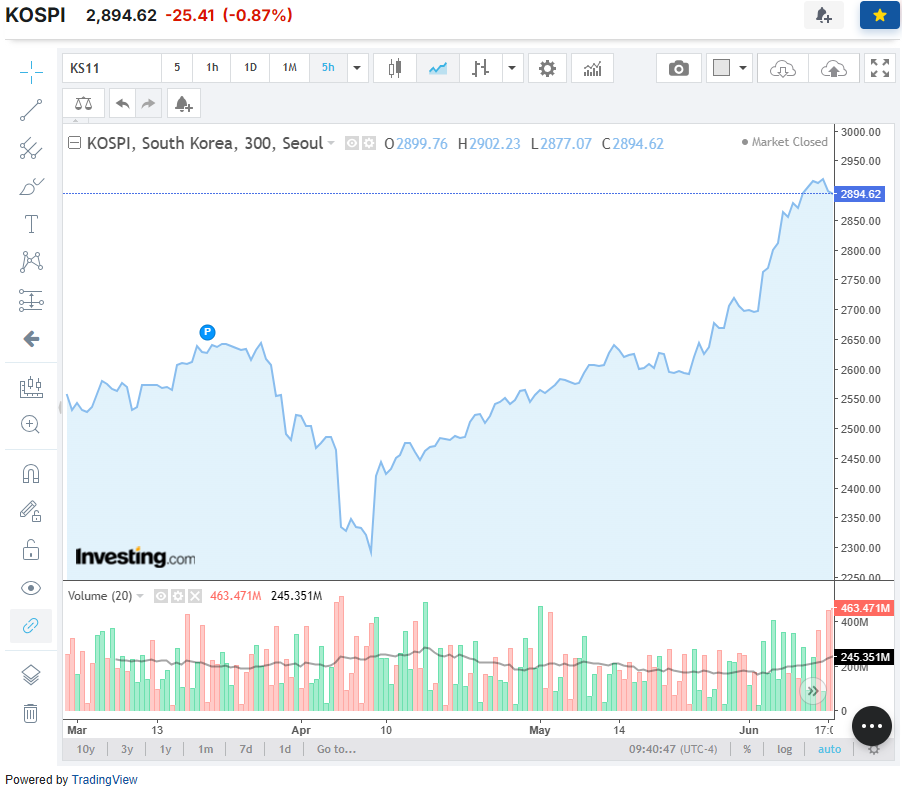
The persistent issues of low PBR and PER (Price-to-Earnings Ratio) in South Korea’s stock market have plagued it for over two decades, consistently acting as a significant deterrent to growth. Shareholder returns have been globally very low, and the practice known as “spin-off listings” (쪼개기 상장, jjogaegi sangjang) has further exacerbated the problem. While the total market capitalization of the Korean stock market has increased through these listings, the KOSPI index’s rise has remained stagnant.
“Spin-off listing” refers to the controversial practice where a company, instead of distributing profits to its shareholders, chooses to list a successful business unit as a separate, new company on the stock market. This means that if a single company continued to operate its successful businesses, its stock price and company value would naturally rise. However, by splitting it into two or three separate listed entities, the value of the original company’s stock is diluted for existing shareholders. A prime example is Samsung Electronics, South Korea’s largest market capitalization stock. Beyond Samsung Electronics, you can find a wide array of other “Samsung” branded listed companies such as Samsung SDI, Samsung Life Insurance, and Samsung Card.

President Lee Jae-myung recognized that the value for individual investors in the Korean stock market had not appreciated for decades. He observed a trend of these investors moving towards stock markets in the United States, China, and India, indicating a clear preference for foreign stocks over domestic ones.
To counter these issues, he publicly pledged to take various measures to revitalize the Korean stock market. In anticipation of these policies, the KOSPI index has seen a sharp surge, climbing from 2,600-2,700 points before the presidential election to its current level of 2,900 points. This rapid ascent reflects a newfound optimism among investors who hope for significant structural improvements.
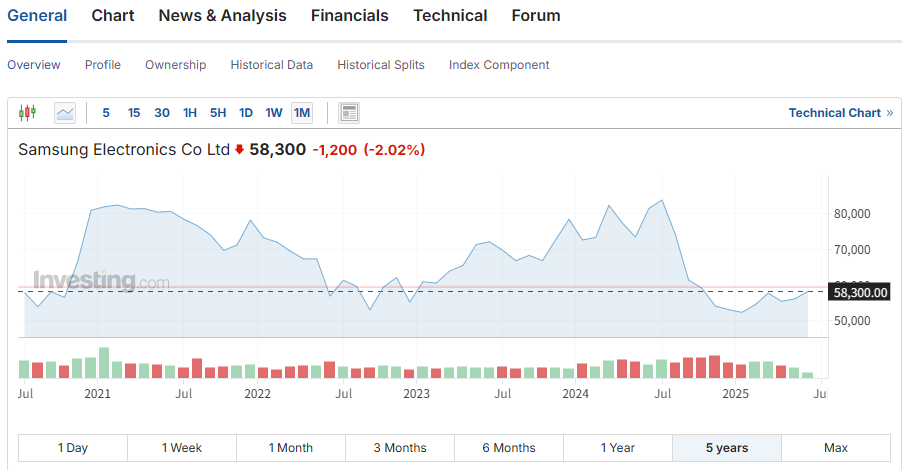
Image Caption: Samsung Electronics, South Korea’s top market cap stock – its stock price has seen little fluctuation, or even declined, for years. (Image Source: investing.com)
While I plan to write more about the Korean economy in future posts, if you are considering investing in the South Korean stock market (KOSPI), I recommend starting with a small amount. Although there are many stocks with low PBR and PER in the Korean market, these very stocks often have a history of maintaining low PBR and PER for years or even decades. The reasons for this persistent undervaluation, often termed the “Korea Discount,” are clear and complex, stemming from factors like opaque corporate governance, low shareholder returns, and the unique issue of spin-off listings.
For now, I recommend investing a small amount, diversified across top market capitalization stocks (e.g., Samsung Electronics, SK Hynix, KB Financial Group). While the new administration’s commitment to addressing the “Korea Discount” through initiatives like the “Value-up Program” offers a glimmer of hope, it is essential for foreign investors to approach with caution and a deep understanding of the market’s entrenched characteristics.
What are your thoughts on these new developments in the Korean stock market? Share your insights and investment perspectives in the comments below!
#SouthKorea #KoreaEconomy