
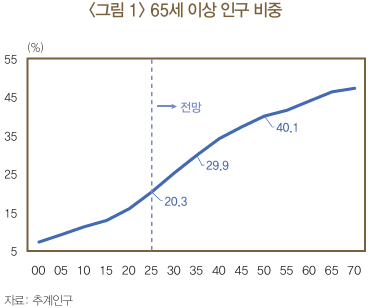
In 2025, South Korea officially entered a super-aged society, with its population aged 65 and over (hereinafter referred to as the elderly population) exceeding 20%. While statistics vary slightly, Korea became an aging society right at the turn of the 21st century, with the proportion of its 65+ population reaching 7% in 2000.
The speed of aging has been unprecedented in human history, accelerating from 7% (aging society) in 2000, to 14% (aged society) in 2018, and then to 20% (super-aged society) in 2025. This demographic shift is projected to continue, with the elderly population expected to comprise 40% of the total population by 2050. (This projection is almost certain as long as the current low birth rate persists).
While 1.01 million babies were born in 1970, the number of births steadily declined, reaching 238,000 in 2024—a quarter of the 1970 figure in just 55 years. Currently, South Korea is at its historical peak in terms of total population, but this figure is expected to gradually decrease moving forward. Currently, South Korea ranks 14th in global GDP, on par with countries like Spain and Australia, having achieved rapid economic development between 1970 and 2000.
This growth, of course, was achieved by working six days a week with almost no holidays, essentially exhausting its workforce. Although the country continues to maintain this status, it has been stuck in a swamp of low growth for the past few years, primarily due to an innovation-lacking manufacturing-based industrial structure and the ongoing low birth rate and aging population.
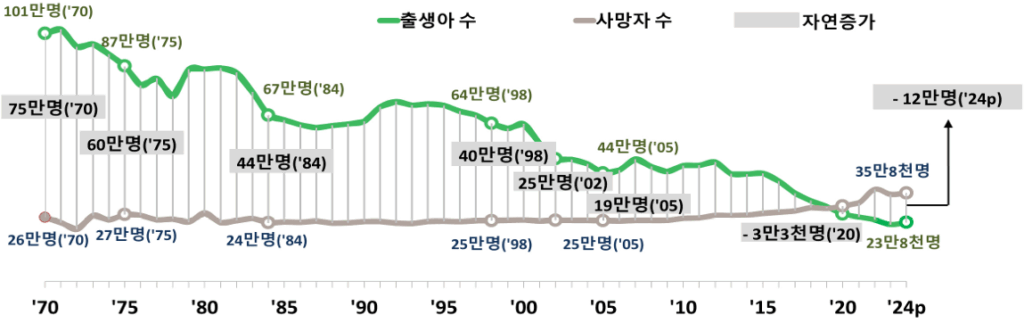
In 1970, over a million children were born in South Korea, but this number gradually decreased, reaching 238,000 in 2024. Notably, while the number of deaths remained between 250,000 and 300,000 for several decades, a ‘dead cross’ occurred in 2020, when deaths began to outnumber births.
South Korea has thus become a country with a declining population. If this trend continues, South Korea’s current population of 51 million is projected to fall below 50 million around 2040 and reach approximately 36 million by 2070.
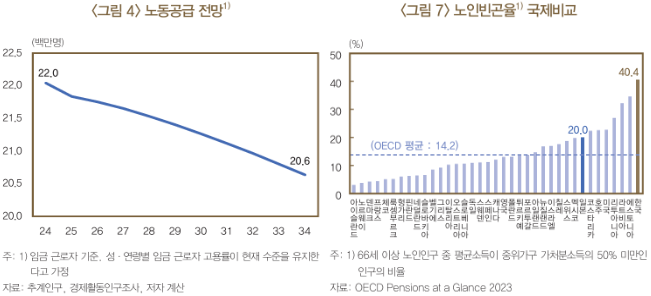
Image 4 – Caption: South Korea’s working population is projected to decrease by 1.4 million, from 22 million in 2024 to 20.6 million in 2034. Meanwhile, the elderly poverty rate exceeds 40%, which is 2.5 times the OECD average. (Image Source: Bank of Korea Statistics)
Although 22 million people are currently employed in 2024, this number is expected to continue shrinking, with an estimated 1.4 million individuals retiring or leaving the workforce by 2034, bringing the total to 20.6 million. The concern is that as these individuals retire and begin receiving pensions, South Korea’s pension funds, which currently exceed 1,000 trillion won, are also anticipated to decrease. Despite diligently working until the age of 65, the poverty rate among South Korea’s elderly stands at 40.4%, nearly three times higher than the OECD average of 14.2%.
While hundreds of millions of won are spent on children’s university education and supporting them until independence, many elderly Koreans find themselves with almost no liquid funds for daily living expenses after paying off their apartment and housing loans. In essence, many become elderly homeowners with practically empty bank accounts. (While not universal, this situation is prevalent among many Koreans.)
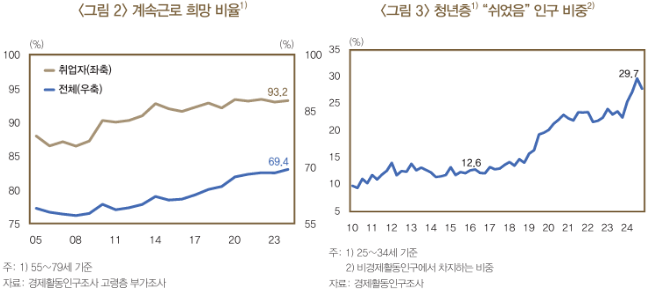
Image 5 – Caption: The graph showing Koreans aged 55-79 who continue to work is consistently increasing, while the proportion of young adults categorized as “resting” (not working or seeking employment) is also rising. This indicates that as older adults continue to work, job opportunities for younger generations are diminishing. (Image Source: Bank of Korea Statistics)
Approximately 70% of the elderly population (aged 55-79) expresses a desire to continue working, and among those currently employed in this age group, the figure exceeds 90%. This indicates a growing proportion of older Koreans who wish to remain in the workforce beyond typical retirement age. The income gap after retirement can exacerbate elderly poverty, and as the elderly population continues to grow, more Koreans are delaying retirement or working longer.
While many workers desire stable employment through extended retirement ages, businesses are concerned about increasing labor costs. There is also worry that a growing number of older workers will reduce job opportunities for the younger generation. The proportion of young adults categorized as “resting” (neither employed nor actively seeking employment) has risen to about 30% in 2025. This means that while the elderly continue to work, the unemployment and “resting” rates among young adults are steadily increasing.
A comprehensive discussion is needed to address various issues, including new forms of employment for the elderly post-retirement, harmonious job allocation between younger and older generations, and easing the burden on businesses. While South Korea faces numerous challenges ahead, I firmly believe and hope for a future that is not entirely bleak.
#Korea #SouthKorea #KoreaSociety